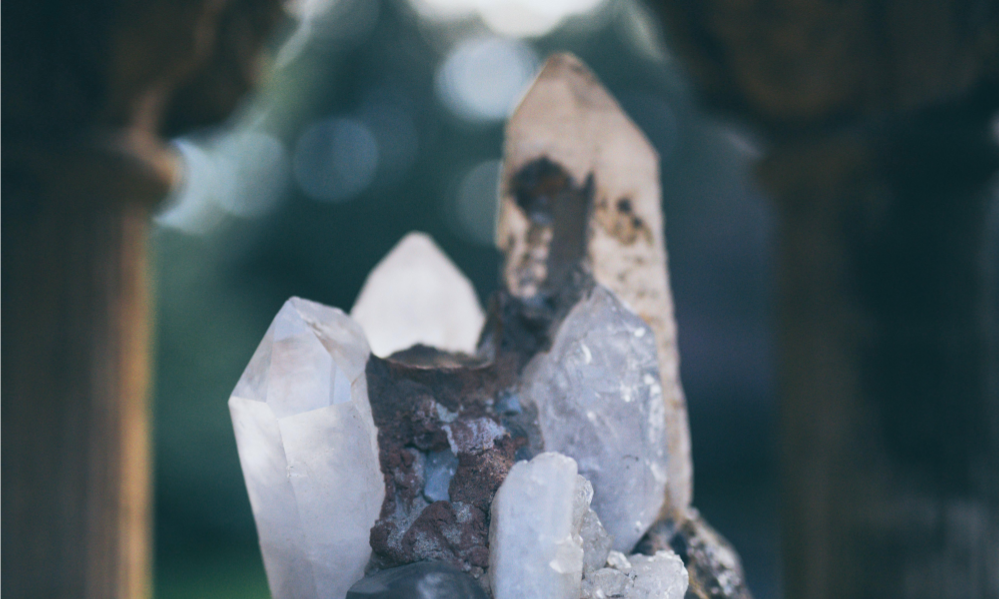
We measure time in days and years. Crystals measure it in millions of both. This disproportion is not merely a geological fact — it is, for anyone who thinks about it for a moment, a genuinely perspective-shifting one. The stone on the wrist was forming before the first human being existed. It will outlast every object manufactured in the last century. Its patience is not metaphorical. It is structural, written into the atomic lattice that gives it its form.
Slow Formation, Stable Result
The stability of a natural crystal — its resistance to wear, its retention of color and clarity, its structural integrity under ordinary conditions of use — is a direct consequence of the slowness of its formation. Crystal growth in geological conditions proceeds at rates measured in fractions of a millimeter per year, under conditions of consistent temperature and mineral saturation that allow each layer to form correctly before the next begins. The result is a structure of extraordinary regularity — a repeating geometric lattice with almost no internal defects at the scale that affects optical or physical properties.
This structural regularity is what distinguishes natural crystal from glass, which is an amorphous solid without the ordered internal structure that gives crystal its characteristic properties. It is also what distinguishes natural crystal from synthetic alternatives grown under accelerated laboratory conditions — faster growth means more internal defects, less optical clarity, and a material that resembles natural crystal superficially while lacking the depth of character that slow formation produces.
Time as a Quality Indicator
The connection between formation time and material quality runs through almost every property that makes natural crystal desirable as a wearable object. The clarity that develops over millions of years of ordered growth. The inclusions that record specific geological events with precision. The color that results from trace elements incorporated gradually rather than added artificially. The surface character that emerges from polishing a material whose internal structure rewards that process rather than simply tolerating it.
Each of these properties is, in a precise sense, the product of time — of the absence of urgency that allowed every aspect of the stone’s formation to proceed at the rate that produces the best result. Wearing natural crystal is, among other things, wearing the evidence of a process that could not have been accelerated without losing what makes it worth having.
What Patience Produces
There is a practical dimension to all of this that matters for anyone considering a natural crystal bracelet as a long-term acquisition. A material formed over millions of years and stable for millions more is not going to degrade meaningfully within a human lifetime of careful use. The color will not fade. The surface will not pit or corrugate with ordinary wear. The structural integrity of the stone will not diminish. What is chosen today will be the same material — duller in surface perhaps, requiring a polish — in twenty years. The patience that produced the stone is available, in a modest way, to anyone who owns it.
Wear what took its time. It will give that time back to you.