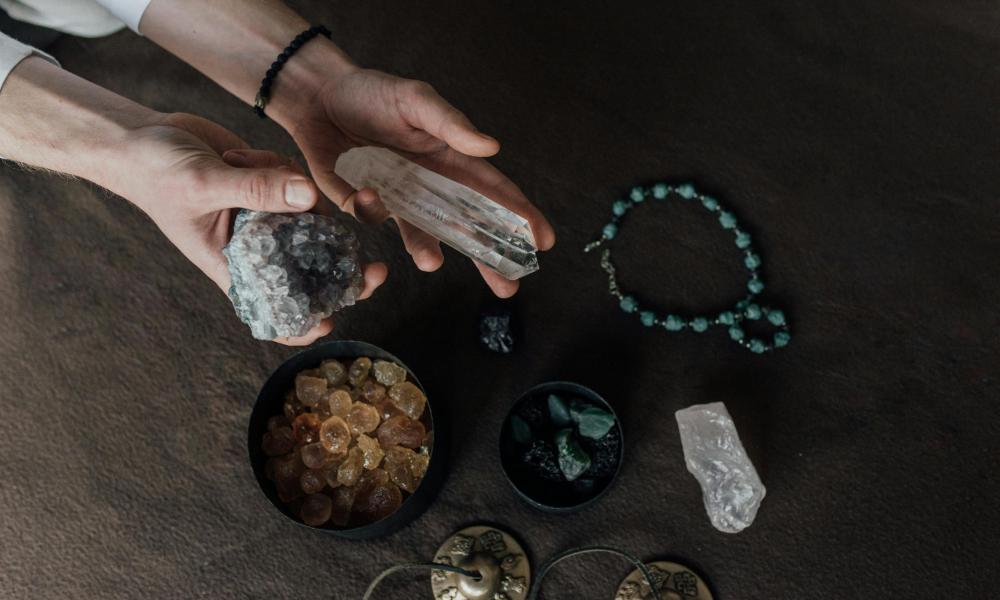
Cut a natural crystal and you find a world inside it. Not metaphorically — literally. Inclusions that record the mineral-rich water that passed through the rock millions of years ago. Fractures that map the precise moment of a geological event. Color gradients that tell the story of changing conditions over time spans that make human history look recent. A natural crystal is not simply beautiful. It is legible, to those who know how to read it.
What the Interior Reveals
The internal structure of a crystal is the record of its formation. Rutile needles suspended in quartz — thin threads of titanium dioxide that caught and held their position as the crystal grew around them — create the phenomenon known as silk, a soft internal luminosity that shifts with viewing angle. Inclusions of chlorite produce the green phantoms visible in certain quartz specimens: ghost-like shapes within the crystal that mark earlier stages of its growth, preserved in three dimensions within the stone.
These are not imperfections. In the language of natural gemstones, they are provenance — evidence that the stone is what it claims to be, formed by processes that cannot be replicated in a laboratory at any meaningful scale. A flawless crystal is often a synthetic one. The interior life of a genuine natural stone is written in its irregularities.
Light as a Collaborator
A crystal bracelet changes throughout the day in a way that no other jewelry quite replicates. Morning light, coming in low and warm, catches the inclusions at one angle and reveals them. Afternoon light, harder and more direct, activates the refractive surfaces and produces the prismatic flash that makes certain stones seem to contain their own light source. Evening light softens everything, and the stone settles into a quieter depth.
This responsiveness to light is not a property added by the jeweler. It is intrinsic to the crystal’s structure — a consequence of the geometry that formed underground, over millions of years, in conditions of complete darkness. The stone spent its entire formation without light, and has spent every moment since finding new ways to interact with it.
Choosing for the Interior, Not the Surface
Most crystal bracelets are chosen for their surface — the color, the polish, the overall aesthetic impression. The more considered choice looks inward. A stone with visible internal character — inclusions, phantoms, zones of varying clarity — is a stone with a story. It will look different in different settings, at different times of day, in different company. It will not exhaust itself aesthetically in the first week of wearing. It will continue to reveal itself, slowly and on its own terms, for as long as it is worn.
The most interesting stones have something to show you every time you look.