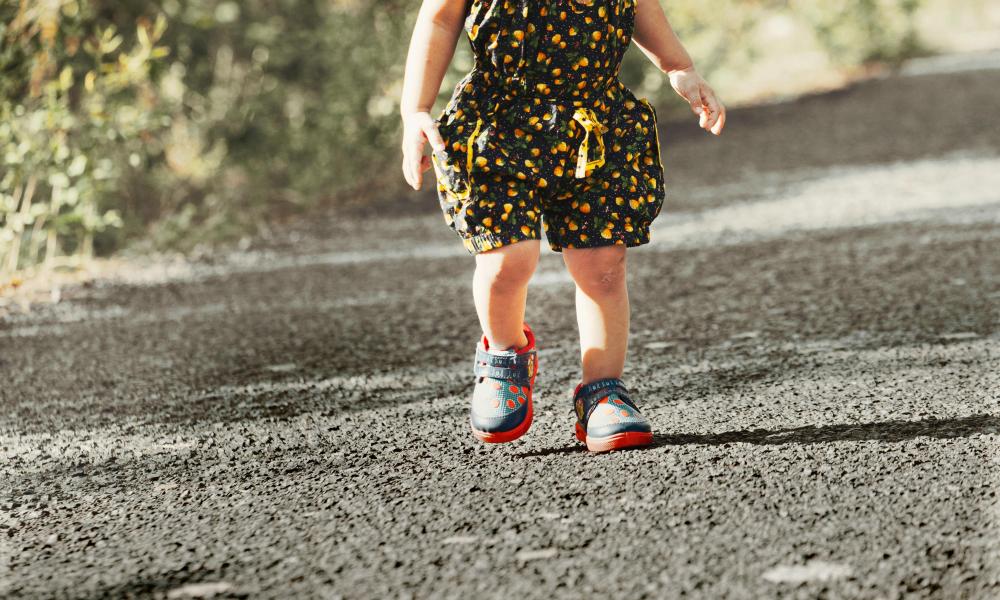
There is a particular kind of attention that small children give to the ground. Before they are tall enough to see very far ahead, the world presents itself primarily as a surface — something to be touched, tested, crossed, and occasionally tasted. A crack in the pavement is an event. A patch of gravel demands a pause. A puddle is a destination. This relationship with the ground is not a phase to be grown out of. It is the foundation — literally — of everything that follows.
How the Foot Reads the World
The sole of a child’s foot contains a remarkable concentration of nerve endings — sensory receptors that transmit information about surface, temperature, pressure, and texture directly to the developing brain. This is not incidental to the process of learning to walk. It is central to it. Research in pediatric development consistently shows that children who have regular access to varied ground surfaces — and footwear that allows them to feel those surfaces — develop stronger proprioception, better balance, and more confident gait patterns than those whose feet are consistently insulated from the ground beneath them.
The implication for footwear is clear. A sole thick enough to protect against sharp objects and cold surfaces is appropriate and necessary. A sole so dense that it eliminates ground feedback is working against the very development it is supposed to support. The target is transmission, not insulation — a sole that filters out harm while allowing the texture of the world to come through.
Stability From the Ground Up
Balance in early walkers is not a cognitive achievement. It is a physical one, built gradually through thousands of small adjustments — the slight shift of weight that compensates for an uneven surface, the unconscious spread of toes that increases the foot’s contact area on a slope, the micro-corrections that happen faster than any conscious thought. Each of these adjustments requires sensory input. Each repetition strengthens the neural pathway that makes the next one faster and more precise.
A shoe that contributes to this process is one with a low profile — keeping the foot close to the ground — a flexible outsole that allows the foot to bend naturally at the ball, and a heel that provides lateral stability without raising the ankle above its natural position. These are not luxury specifications. They are the minimum requirements for a shoe that is genuinely developmental rather than simply protective.
The Fit That Keeps Pace
A developing foot does not wait. During peak growth phases, a child can move through an entire shoe size in six to eight weeks — and the consequences of a shoe that has become too small are not always immediately visible. Compression of the forefoot during this period can influence the alignment of developing bones in ways that become apparent only later, when the cartilage has ossified and the pattern is set. Checking fit regularly — every six weeks during the first two years of walking — is not overcaution. It is the most straightforward form of developmental care available.
The ground is their first teacher. Give them a shoe that lets them listen.