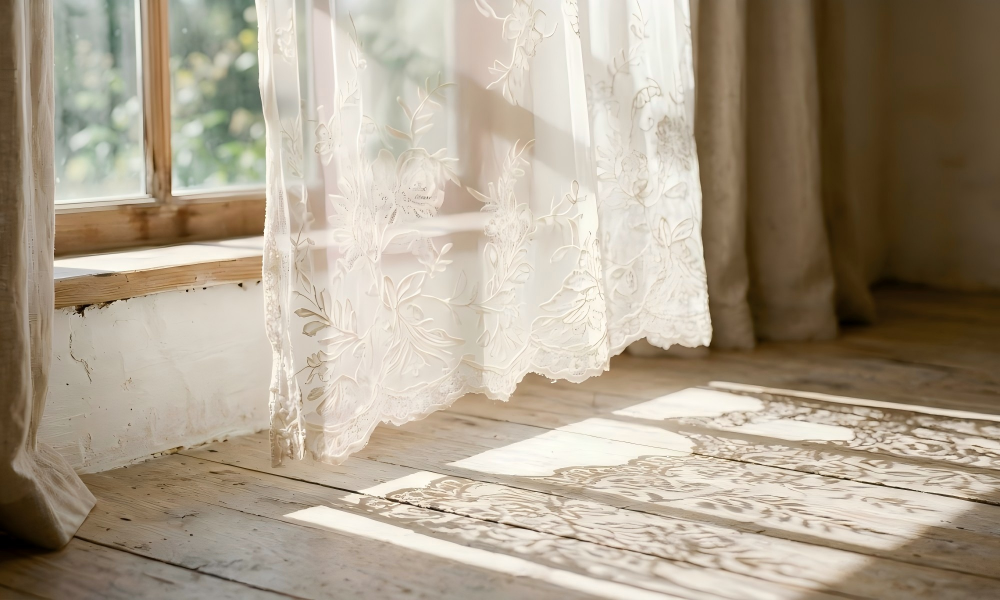
A haiku says everything with almost nothing. Seventeen syllables. Three lines. A whole world compressed into the space between words. Fine lace works the same way — not despite its gaps, but because of them. The negative space is not absence. It is the point.
The Architecture of Emptiness
Every other fabric defines itself by what it contains. Lace defines itself by what it leaves open. The holes are as considered as the threads — each gap a deliberate choice, each void part of the pattern. This is not a limitation of the medium. It is its highest expression. A piece of fine lace is an argument, made in fiber, that what you leave out matters as much as what you put in.
Where Light Becomes the Material
Hang lace at a window and something changes. The fabric stops being a fabric and becomes a filter — catching the light, breaking it, projecting its patterns onto the floor below in shapes that shift through the day. The room acquires a rhythm it did not have before. Morning looks different from noon. The same window, endlessly reinterpreted. This is not decoration. This is the textile equivalent of a poem that reads differently every time.
The Detail That Changes Everything
A lace trim on a hem. A lace runner across a table. A lace panel where there was only glass before. None of these are large interventions. All of them are felt immediately. Lace has this quality — of transforming a space or a garment without overwhelming it, of adding without crowding, of being unmistakably present while taking up almost no room at all.
Some things say the most by leaving space. This is one of them.