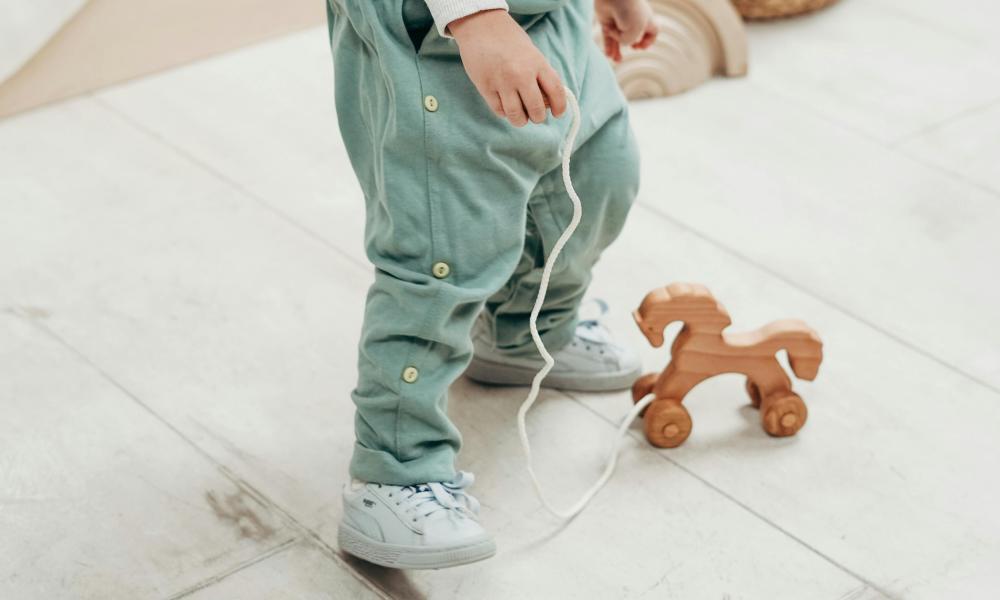
Watch a child learning to walk and you will notice something that no amount of encouragement produces on its own: the moment when hesitation becomes momentum. It is not a decision, exactly. It is a physical discovery — the realization, encoded in muscle and balance rather than thought, that the next step is possible. This transition happens differently in every child, on its own timeline, and it cannot be rushed. But it can be supported, quietly and from the ground up.
The Architecture of Early Balance
Balance in a new walker is not a fixed achievement but an ongoing negotiation — a continuous series of micro-adjustments between the foot, the ankle, and the surface below. Each adjustment requires information, and that information comes primarily from the sole of the foot. A shoe that transmits ground texture accurately gives the nervous system more data to work with. More data means faster adjustments. Faster adjustments mean fewer falls, and the falls that do happen are smaller and more controlled.
This is why sole flexibility matters as a developmental specification rather than simply a comfort one. A sole that bends with the foot allows the toes to participate actively in balance — spreading to increase contact area on uneven surfaces, gripping slightly on slopes, flexing through the push-off phase of each step. A rigid sole removes the toes from this process entirely, leaving the child to balance on a platform rather than a foot.
Stability Without Restriction
There is a version of stability in children’s footwear that works against the child rather than with them — the high ankle boot that prevents the natural range of ankle motion, the stiff counter that holds the heel so firmly it prevents the micro-movements that build ankle strength over time. Genuine stability at this age means something more specific: a heel that resists lateral rolling without limiting forward motion, and a fit snug enough to prevent the foot from shifting inside the shoe without being tight enough to compress it.
The distinction matters because a child whose ankle motion is artificially restricted does not develop the stabilizing musculature that natural movement would build. The shoe compensates for a weakness it is simultaneously preventing from being resolved.
The Role of the Upper
The upper of a children’s shoe is in direct contact with the foot for hours at a time, across days and weeks of active use. Its material properties determine the thermal and moisture environment inside the shoe — and a child’s foot, with its high metabolic rate and concentrated sweat glands, is a demanding environment to manage. Natural leathers and technical meshes that allow moisture to move outward maintain a microclimate that stays comfortable across a full day of play. Synthetic materials that trap heat and moisture create conditions that lead to irritation long before they create visible problems.
Give them the ground. Give them the room. The confidence takes care of itself.